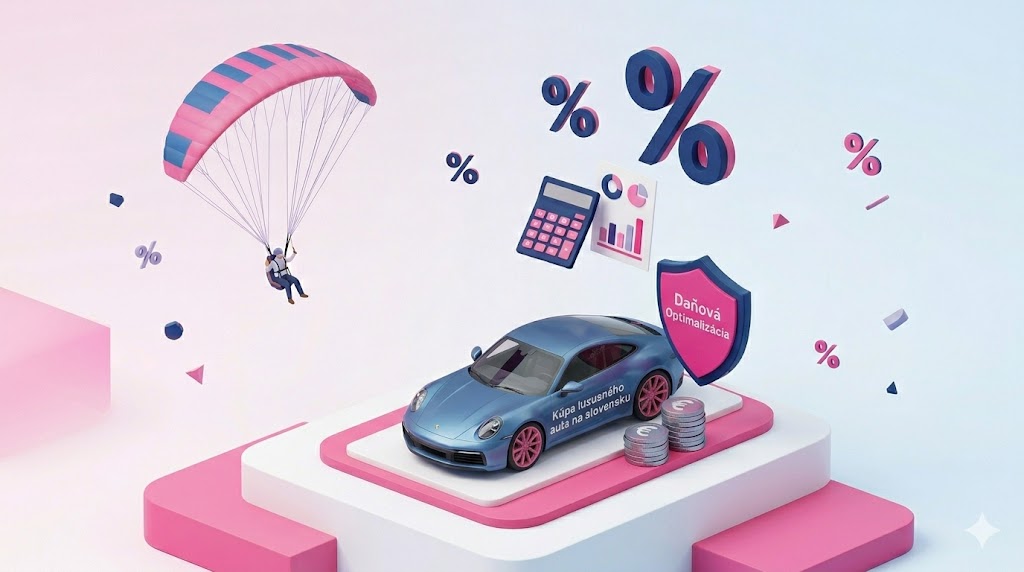
Complete guide:Purchase of a luxury car in the EU to a Slovak s.r.o. (from the perspective of a Polish owner)
Slovakia offers for entrepreneurs interesting tax conditions, which are often used also by citizens of neighboring Poland. If you are a Polish citizen and you own a Slovak s.r.o., which is a VAT payer, the purchase of a luxury car from another Member State of the EU (e.g. from Germany or the Netherlands) brings several advantages, but also administrative rules.
The goal of this article is to analyze in the smallest detail how to proceed so that you can legally apply 100% VAT deduction, avoid limits for luxury cars in income tax and correctly set its leasing.
Step 1: Purchase of the car and correct transport (VAT rules)
If your Slovak s.r.o. buys a car from a VAT payer from another EU country (e.g. Germany), from the perspective of the law it is acquisition of goods in the domestic country. However, the key condition is that the car must be physically transported to Slovakia.
- Attention to transport directly to Poland: If you would buy the car to a Slovak s.r.o. (under a Slovak VAT ID), but you would let it be transported from Germany directly to your home to Poland, you would lose in Slovakia the right to VAT deduction and your Slovak company would have to register for VAT as a foreign person in Poland.
- Solution: Always ensure that the first journey and physical delivery of the vehicle go to the territory of Slovakia.
Step 2: How to obtain 100% VAT deduction?
Slovak tax law from January 1, 2026 introduced new limitations in § 85n of the VAT Act. If you are buying a luxury car and want to deduct VAT in full (100% scope), it is necessary to meet a strict condition: you must use the car exclusively for business purpose, for example: leasing or short term rental.
- Without mileage log: If you use the car exclusively for leasing (for example the Slovak s.r.o. leases it to another of your Polish company or to third persons), the law relieves you from the obligation to keep a detailed mileage log.
- Proofs of leasing: However, you must be able to prove that the car serves only for leasing. Proper lease contracts and handover protocols, which contain the odometer status at handover and return of the vehicle, will serve for this.
- Private rides: If you would want to use the car also for private rides (e.g. as managing director of the Slovak s.r.o.), you lose the right to automatic 100% deduction. In such case you would have to keep an exact mileage log and prove the exact proportion of business use.
- Notification obligation: Do not forget that the use of a passenger car (whether exclusively for leasing or for normal business) you must as a VAT payer newly notify to the tax office on the prescribed form, within the deadline for submitting the tax return for the period in which you deduct VAT.
Step 3: Where and to whom to lease the car? (Place of supply and VAT)
Leasing of a vehicle has specific rules depending on whether it is short-term (up to 30 days) or long-term (over 30 days) leasing. These rules directly determine in which country VAT will be paid.
- Short-term leasing (max. 30 days): VAT is paid in the country where you physically make the car available to the customer.
- If you hand over the car in Slovakia to a Polish citizen or company, the rent is subject to Slovak VAT.
- If you hand over the car physically in Poland to a Polish company (VAT payer), reverse charge may apply to the Polish company (if Polish law allows it). If you hand it over in Poland to a regular citizen, you pay Polish VAT and must register there (or use the OSS scheme).
- Long-term leasing (over 30 days): Physical place of handover does not decide here.
- If you lease the car to a Polish company (taxable person with assigned Polish VAT ID), the leasing is not subject to Slovak VAT. You invoice without VAT with transfer of tax obligation to the Polish lessee and you state the transaction in the summary report in Slovakia.
- If you lease the car long-term to a Polish citizen (non-entrepreneur), the rent is subject to Polish VAT and your Slovak s.r.o. must register for VAT in Poland.
Step 4: Trap on “luxury” cars in income tax
Slovak Income Tax Act limits tax depreciation for so-called “luxury” cars (passenger cars with acquisition price €48,000 and more). If you do not depreciate such an expensive car due to insufficient tax base, a problem arises.
However, we have here an excellent legal exception: If your Slovak s.r.o. is in the position of lessor and leases the car based on an operating contract without a pre-agreed right of purchase (without option to buy), this limit on luxury vehicles does not apply to you.
Nevertheless, you must pay attention to another rule: depreciation from leased property you can include in tax expenses at most up to the amount of your income from leasing of this car for the relevant year. That means that the car should actually earn (for example by leasing to your Polish company) such an amount that at least covers the annual depreciation of the car.
All other operating costs, such as repairs, insurance or motorway vignettes, are fully tax-recognized, if according to the lease contract they are borne by the lessor and serve to maintain taxable income from leasing.
Step 5: Withholding tax when leasing to Poland
From the perspective of taxes we must not forget international treaties. If a Slovak s.r.o. leases a vehicle to a Polish company (for business), rent for a movable thing is considered as so-called industrial royalty.
According to Article 12 of the Treaty on avoidance of double taxation between Slovakia and Poland, Poland as the source of income may tax this fee, however the tax must not exceed 5% of the gross amount. The Polish company is therefore obliged when paying rent to withhold 5% tax. This withheld amount the Slovak s.r.o. can subsequently credit in Slovakia in its tax return, thereby avoiding double taxation.
Step 6: Motor vehicle tax
A car registered in Slovakia (with Slovak license plates), which is used for business – which leasing also is – is subject to annual Slovak motor vehicle tax. The amount of tax decreases or increases based on the age of the vehicle. The person who pays this tax is standardly the one who is registered in the Certificate of Registration as the holder (if you lease the car to a Polish company under operating lease and the holder in the technical certificate remains your Slovak s.r.o., the taxpayer is the lessor).
Tip at the end for fans of ecology: If you decide for a pure electric vehicle (BEV), the annual rate of motor vehicle tax in Slovakia is currently exactly 0 euros.
Partial Summary:
Purchase of a luxury car in the EU to a Slovak s.r.o. is for a Polish owner an excellent move. If you bring the vehicle to Slovakia and establish a business model on exclusive operating leasing (for example to a related company in Poland without right of purchase), you avoid the Slovak limit on luxury cars for depreciation and obtain absolutely trouble-free entitlement to 100% VAT deduction without annoying bureaucracy in the form of writing a mileage log. Here is the added continuation of the blog article, which in detail compares purchase to a Polish company and adds an illustrative case study with specific numbers.
Step 7: What are the costs and limitations when purchasing a car to a Polish company (Sp. z o.o.)?
If you would decide not to purchase the luxury car to a Slovak s.r.o., but to your domestic Polish company, you will encounter several strict limitations and additional taxes, which Polish legislation applies to cars.
- Excise tax (Akcyza): At intra-Community acquisition (purchase from another EU Member State to Poland) of a passenger car arises in Poland the obligation to submit declaration AKC-U/S and pay excise tax. For cars with engine capacity above 2,000 cm3 this tax is extremely high – it represents up to 18.6% of the relevant tax base. For engines with smaller capacity it is a rate of 3.1%.
- Limited VAT deduction in Poland: If the vehicle on a Polish company would be used even partially for private purposes (so-called mixed use), Polish regulations order proportional reduction and from the purchase you can deduct only 50% VAT. In order to deduct 100% VAT in Poland, the car must be used exclusively for business purposes with fulfillment of strict statutory formal requirements.
- Limits on depreciation in income tax: Polish law also limits the amount which you can include from a luxury car into costs. For example even for fully electric passenger cars this limit is capped at 225,000 PLN (approximately €50,000) and for cars with combustion engine it is even lower. Any value of the luxury car above this limit does not represent a tax expense.
- Tax on civil law transactions (PCC): In standard domestic sale of cars in Poland a rate of PCC in amount of 2% from the market value of the vehicle is commonly applied. (However, when purchasing to a company with invoice and VAT, exemptions apply).
Case study: Purchase of Porsche 911 from Germany (€200,000 without VAT)
For better understanding let us compare the situation. The buyer in both cases is a VAT payer and purchases the car from another EU country (e.g. Germany) also from a VAT payer. It is a luxury Porsche 911 (engine capacity clearly above 2,000 cm3), whose price is €200,000 without VAT.
Scenario A: Purchase to a Polish Sp. z o.o.
- Excise tax (Akcyza): Since the car has engine above 2 liters, immediately upon import to Poland you pay the state excise tax in amount of 18.6% of value. That is an immediate non-refundable cost in amount of €37,200.
- VAT deduction: With expensive sports cars it is difficult to prove 100% business use and often mixed use by the managing director occurs. Then you have in Poland the right to deduct only 50% VAT. That means a huge VAT loss, which permanently lapses and makes the purchase more expensive.
- Income tax: Even if you would lease the car exclusively, from the acquisition price (which together with excise tax exceeds €237,000) you will include into tax costs in Poland only the legally allowed limit for cars with combustion engine (which is a fraction of real price). The remaining hundreds of thousands of euros you will pay from your taxed company profit.
Scenario B: Purchase to a Slovak s.r.o. and leasing model
- Excise tax (Akcyza): In Slovakia at import of a passenger car no excise tax at all is paid regardless of engine power. Cost for excise = €0.
- VAT deduction: You transport the vehicle to Slovakia and the Slovak s.r.o. on paper based on a contract starts to exclusively lease it to your Polish company or to you as a natural person. According to Slovak VAT Act in case of exclusive leasing you have automatic entitlement to 100% VAT deduction, and even without obligation to keep a detailed mileage log. The EU transaction is carried out in the form of self-taxation and does not take any money from your cashflow.
- Income tax: Although Slovakia also limits tax depreciation for cars above €48,000, this limit does not apply to you. Thanks to the fact that the s.r.o. acquired the car for the purpose of leasing without purchase option (operating lease), it can gradually include the entire €200,000 into costs through depreciation. The only condition is that the s.r.o. invoices from leasing at least an amount corresponding to the annual depreciation.
- Other fees (Motor vehicle tax): In Slovakia for such a car (up to 3,000 cm3) you pay only local annual motor vehicle tax, which for a new car is a ridiculous €218 (for electric vehicles it would even be €0).
Conclusion of comparison:
If you register and tax a Porsche 911 for €200,000 in Poland, your company immediately loses tens of thousands of euros only on excise tax and further on lost 50% VAT. However, if you do the same process smartly through a Slovak s.r.o., thanks to removal of the limit in leasing you depreciate the entire €200,000 and you do not pay any excise tax to the state. You can thus save an amount equal to another luxury vehicle.

Mgr. Dominik Ondrišeje
Dominik is co-founder of the SetupMART project. Dominik is responsible for corporate services and implementation of modern technologies in our services at SetupMART. Dominik is dedicated to the sale of ready-made companies since 2011. Dominik studied law at the Pan-European School of Law.